THIS GENERATION”
What Jehovah’s Witnesses Teach
The Bible Students (as Jehovah’s Witnesses were formerly called) were very concerned about the end and created a sense of urgency since the end could come at any time. The Bible Students focused on a statement in Luke 21:24 that the appointed times of the nations will end and then they looked for a way to date to the end.
The generational doctrine of Jehovah’s Witnesses is based on Jesus’ statement at Matthew 24:34 —”this generation will by no means pass away until all these things happen.” How did the generational doctrine of Jehovah’s Witnesses develop?
In Jehovah’s Witnesses official website, JW say that in 1876, their founder Charles Taze Russell published the article “Gentile Times: When Do They End?”. He developed a mathematical method of calculation that led him to conclude that Armageddon would come in 1914. He referred to 1914 as the end of “the appointed times of the nations.” When Armageddon did not come in 1914, the Bible students were disappointed. It did not help the situation that Russel himself died in 1916. Based on the decrease in members attending the Bible students memorial, indicates that about 75-80% of the members left.
The new president, Rutherford, tried to temper the disappointments and maintain expectations of the end through the lecture “Millions Now Living Will Never Die”, in which he created a new expectation that 1925 was the year of the end. Jehovah’s Witnesses themselves refer to the period from 1914 to 1918 as “a period of trial.” The actual explanation of Rutherford’s prophecy was mentioned as late as in 1962 with the article “Gods New World in Our Generation” linked to Matthew 24:34. This was then pushed in an article in 1984 called “1914 – The Generation That Will Not Pass Away”. Thus, Jehovah’s Witnesses found a way to link Russell’s expectations related to 1914 (written in 1876) to Rutherford’s created time pressure that millions would not die (published in 1918).
In the 90’s, as Jehovah’s Witnesses realized that the generation born before 1914 was dying out, a new understanding of this doctrine was developed in 1995. The idea now was that “this generation” was not linked to a cohort, but to a group of people who characterize a certain attitude. Yet, Jehovah’s Witnesses argued that this adjustment should continue to “stimulate us to be at God’s work urgently.”
Thus, the organization was still concerned with motivating its members with a sense of urgency and increased effort in the ministry. In 2008, the understanding was nuanced with an overlap model, and in 2010 the overlap model was explained in more detail, where “this generation” consists of two groups of people who have lived at the same time at some point. The first group is made up of people who lived in 1914, and the second of those who overlapped with the last members of the first group.
It was important for JW to uphold the 1914 teaching. If the 1914 theory collapse, then the argument that the Governing Body was appointed by Jesus as leaders in 1919, will also collapse. Jehovah’s Witnesses have chosen repeated adjustments to their teachings rather than reconsidering the entire 1914 teaching. One thing is certain, neither Russell’s original 1914 doctrine nor later revisions of the generational doctrine have come true.
What the Bible Says
Matthew chapter 24 contains two different questions that should not be mixed up.
- When will the temple be destroyed? (verse 1,2)
- What is the sign of Jesus’ coming? (verse 3)
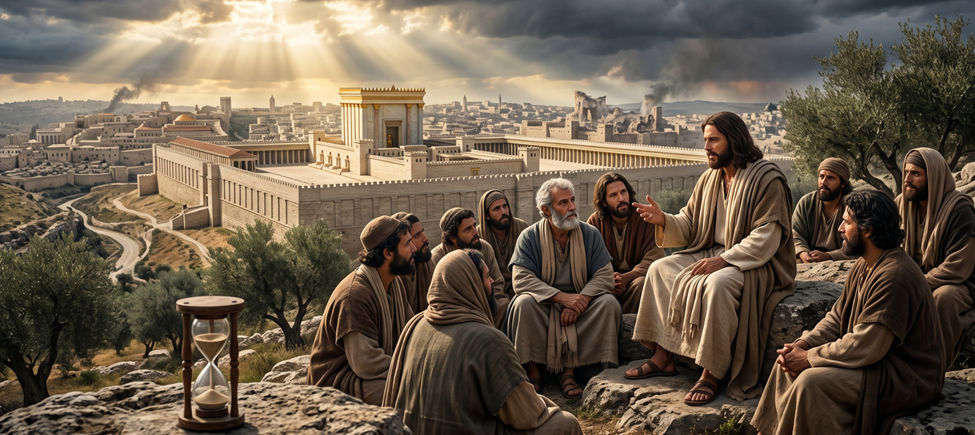
When verse 34 uses “this generation”, it refers to the generation that stood before Jesus when Jesus spoke to them. The disciples had taken him to the temple buildings to ask about the fall of the temple (verse 1). When Jesus in verse 34 says that “this generation will by no means pass away until all these things happened”, they are talking about the fall of the temple. The generation that stood right before Jesus would not disappear until the temple was destroyed. The generation that lived in year 33 was still alive when the temple was destroyed 37 years later in year 70.
The “generation” Jesus talked about cannot have been an answer to the question of when Jesus would return to earth for the second time, simply because the generation Jesus spoke to is already extinct and Jesus still hasn’t returned.
It seems that some end-time prophets may have confused the two different questions that Jesus talks about in Matthew chapter 24. They mixed up the theme of generation with the coming of Jesus.
The answer to the question in verses 1 and 2 about the destruction of the temple is discussed in verses 15–22 and 32–34.
The second question, about Jesus’ coming, is set out in verse 3. Jesus answers this question over verses 4-14, 23-27, and 29-31.
There are many opinions about why Jesus chose such a structure for his answer. The fact is that the generation Jesus spoke to is extinct almost 2000 years ago, while our generation is still waiting for Jesus’ coming.